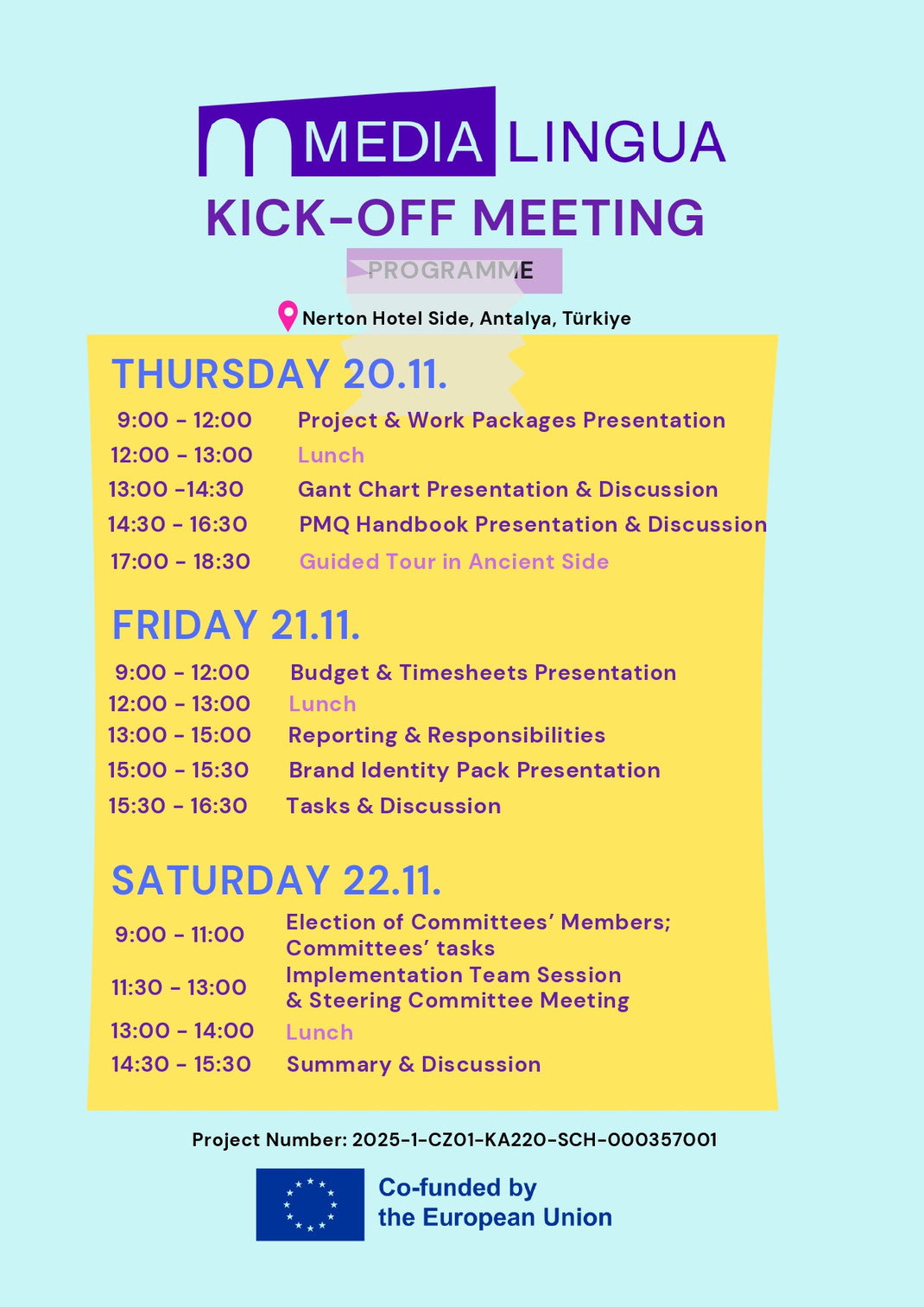
TPM 1 Kick Off Meeting, Manavgat, 19th-23rd November 2025
This Tpm Kick-off meeting was:
Revolution in the Classroom at ITC Chironi. “Medialingua” Brings Innovation
Erasmus+ project to teach how to “Build Bridges” between languages. A KA2 project supports students and teachers in the Art of Linguistic Mediation.
On November 19th, the Erasmus+ Key Action 2 project titled "MEDIALINGUA: Mediation in Language Education" officially began in Menavgat, Turkey. With funding of €400,000.00, this three-year project (from 01/10/2025 to 30/09/2028) aims to revolutionize the teaching of foreign languages by providing teachers with training and practical tools focused on mediation.
The central concept of the "Medialingua" project derives from the CEFR Companion Volume (2020) (Common European Framework of Reference for Languages). This update expands the focus of the 2001 CEFR and introduces Mediation as a fundamental activity. Mediation views language users as "social agents who construct bridges and create shared understanding."
The objective of "Medialingua" is to support teachers with practical tools and training specifically for integrating this competence. The project focuses particularly on the three main types of Mediation:
-
Mediating Texts
-
Mediating Concepts
-
Mediating Communication
The International Team at Work
The project is coordinated by Biskupské Gymnázium Brno (Czech Republic) and involves a strategic partnership that includes universities and schools, among them Masarykova Univerzita (Czech Republic), Kemer Fatma Turgut Sen Anadolu Lisesi (Turkey), Otaniemen lukio (Finland), as well as our own Technical and Commercial Institute Chironi Satta of Nuoro and Orosei.
Each partner has a specific role: for example, Masarykova University is responsible for webinars and material development, while the Nuoro school, Chironi Satta, is responsible for developing online resources and sharing materials. The expected outcomes are practical resources for everyone.
Expected Results: Practical Resources for All
"Medialingua" promises to leave a rich legacy of comprehensive educational resources, accessible to interested teachers, students, and parents, such as teaching materials. The project will create a final pool of 240 practical activities, consisting of 120 micro-activities (5–10 minutes) and 120 medium-length activities (15–20 minutes). In addition, 12 complete lesson plans (60 minutes) will be developed.
The materials will be organized for CEFR levels A2, B1, and B2 and will be available in four languages: English, French, German, and Spanish, in addition to Italian, which in our Institute can be tested by teachers who do not know foreign languages but have foreign students in their classes, whom they want to help by using this methodology.
For teacher training, 4 recorded webinars will be provided, covering the context of the CEFR-CV and the three types of mediation.
Furthermore, a multilingual digital portal containing the teaching activities, webinars, and the eBook will be launched via several digital platforms. A multilingual eBook will also be published for easy consultation.
Students as Key Players Through Field Tests
The project is highly practical and actively involves students and teachers in the testing and refinement phase. The process of creating activities occurs through two piloting cycles: an internal piloting (within the individual schools) and an international piloting.
The partners host Learning, Teaching & Training Activities (LTTAs), which are international meetings dedicated to practical experimentation. Students (between 15 and 18 years old) and teachers from each partner school will participate in these meetings.
Students will have a crucial role, completing questionnaires and participating in discussions to provide direct feedback on the activities, ensuring that the materials are effective and adaptable in multicultural contexts. The anticipated impact is an increase in teacher confidence in mediation strategies and an improvement in students' cultural understanding.
The final activities, which aim to be of high quality, variety, and aligned with levels A2–B1–B2, will be completed and validated by university experts and made available for free consultation through a dedicated portal and an eBook, with a launch planned for May 2028.
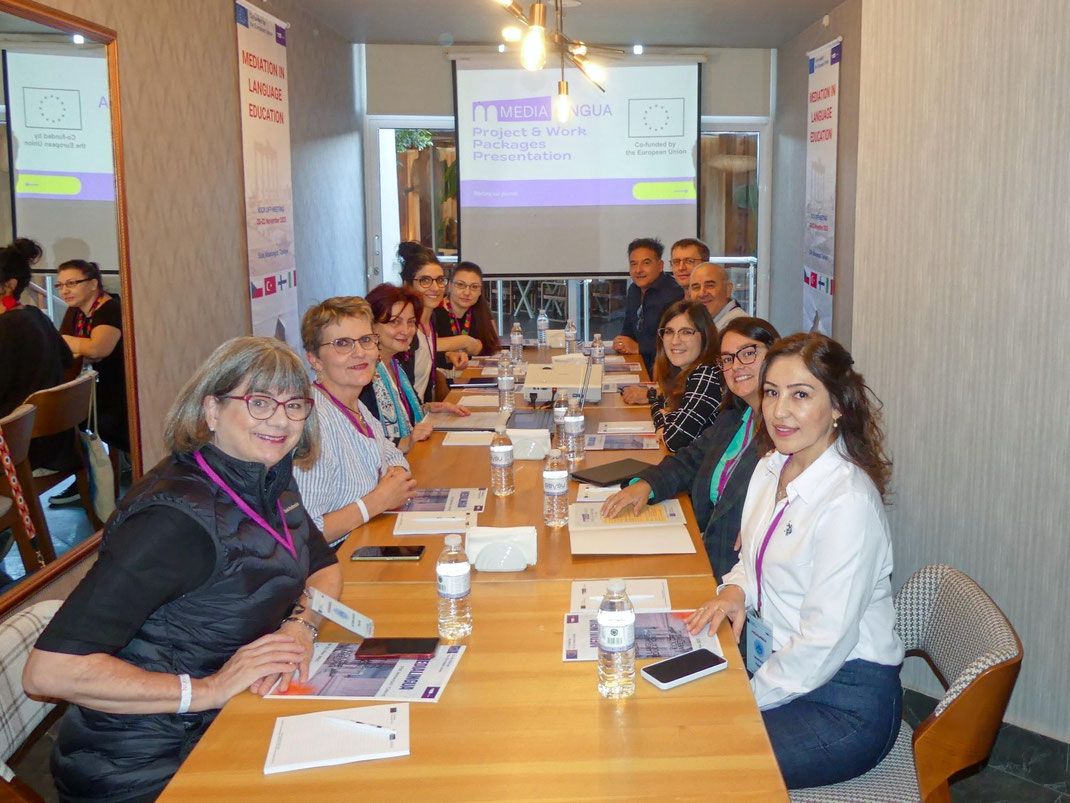
What have we done during the kick off meeting:
The Kick-Off Meeting for the MEDIALINGUA project, which took place in November 2025, marked the official commencement and foundational phase of the project. This meeting fell under WP1: Project Management and Quality Assurance, specifically within the A1.1 SET-UP phase, which covers the first three months of the project.
Based on the documentation, the primary activities and outcomes of this foundational meeting focused on establishing governance, management structures, and assigning the immediate next steps required to begin developing mediation content:
1. Project Management and Governance Setup
A major goal of the Kick-Off Meeting was to formalize the management and quality assurance structures necessary for the three-year project:
• Establishing Committees: The participants likely established the framework for the project’s governance bodies, which include the Steering Committee, the Quality and Risks Committee, and the Implementation Group (Project Team).
◦ The Steering Committee (led by the Coordinator BIGY) is responsible for management, reviewing progress, making key decisions, managing risks and finances, and budget oversight.
◦ The Quality and Risks Committee (also led by BIGY) oversees quality assurance, creates the Quality and Risks Manual, and establishes evaluation methods.
◦ The Implementation Group (Project Team), which acts as the creative team, coordinates daily activities, tracks progress, and plans next steps.
• Documentation and Monitoring: The meeting initiated the process for key project documents, such as the Partnership Agreements and the Handbook, which were scheduled to be completed around this time.
• Financial and Reporting Framework: Budget control mechanisms were put in place, relying on internal records and periodic spending updates to ensure transparency. Partners were reminded that they needed to Hand in Timesheets & Budget Report in December 2025, indicating that the administrative procedures were detailed at the KOM.
2. Launching Content Creation (WP2 Preparations)
The meeting served as the formal start of the content phase (WP2), outlining the initial pedagogical tasks for the partner schools:
• First Webinar Planning: The Kick-Off preceded or immediately introduced the content of the First Webinar on Mediation. This webinar focuses on understanding the concept of Mediation in the CEFR Companion Volume (2020), distinguishing the three main types of Mediation (Text, Concepts, Communication), and discussing teaching contexts and activity planning.
• Initial Activity Selection: The partners received their first content tasks, scheduled for Nov 2025 - Mar 2026:
◦ Set up your school’s Project Team (creators), consisting of 3–5 teachers per school.
◦ Select & Test existing activities on Mediation. This involves researching and selecting 25 micro or medium-length existing activities and 4 lesson plans (covering all three types of Mediation and different levels: A2, B1, B2) to be tested internally in their classes.
• Preparation for Mobility (LTTA1): Participants needed to Select their team for LTTA1 (students & teachers), ensuring fair and transparent selection procedures, and were advised not to hesitate with travel arrangements. LTTA1 was scheduled for March 2026.
3. Branding and Dissemination Expectations
The partners were instructed on consistent project procedures and public representation:
• Branding and Identity: The project’s Brand Identity and EU Logo were introduced, and partners were instructed to use them consistently.
• Dissemination Requirements: All partners were reminded to Keep documenting, publishing & disseminating activities and to Use the Central Repository for materials.
In summary, the Kick-Off Meeting established the organizational backbone of MEDIALINGUA and acted as the launch pad for the intensive WP2 Materials Creation phase, ensuring all partners understood the project's structure, their immediate responsibilities, and the first steps toward developing the mediation activities.